Building a Sustainable Profit Model for Freshly Made Beverage Operations in Group Catering: A Systematic Operating Framework and Practical Guide
### Building a Sustainable Profit Model for Freshly Made Beverage Operations in Group Catering
**title**: Building a Sustainable Profit Model for Freshly Made Beverage Operations in Group Catering
**keywords**: TEDIA, group catering, freshly made beverages, smart beverage system, APCP, light-operation model, product engineering, standardized operations, profit model, digital operations
**publication date**: 2026-04-15
**source**: Originally published on TEDIA Tech official website
Under highly constrained group catering systems, traditional manually prepared beverage models struggle to achieve stable and scalable operations. TEDIA introduces a light-operation paradigm powered by smart beverage systems and product engineering, enabling standardized execution, locked cost structures, and deployable profit units that transform freshly made beverages into a stable, internalized source of revenue.
How Freshly Made Beverage Operations Can Be Established Within Self-Operated Group Catering Systems
Under the traditional assumption of “manual preparation,” operational judgment typically presents a contradiction: while the profit structure suggests viability, execution lacks a stable and feasible self-operated pathway.
Group catering is a highly constrained operating system:
Customer traffic is highly concentrated within short time windows
The same customer base consumes repeatedly over the long term
Food safety and compliance are top priorities
Organizational structures are not suited to increased complexity
Within such a system, a model that relies on “cup-by-cup manual preparation” will inevitably amplify operational issues, including:
Imbalance between labor shortages and redundancy
Variability in taste and service speed depending on staff
Uncontrolled raw material loss
As a result, freshly made beverages have long existed in group catering primarily in the form of outsourced services.
The limitation is not profit potential, but the lack of an operational capability that can reliably deliver expected outcomes.
The real question is: How can group catering enterprises develop standardized, engineering-based operational capabilities for freshly made beverages, enabling stable operations and internalized profits under highly constrained conditions?
A Shift Underway: From “Manual Preparation” to “Engineered Capability”
The operational model of freshly made beverages has fundamentally changed.
In professional beverage systems, production is shifting from human-dependent preparation to output driven by product engineering and system execution.
Key elements are now defined upfront and unified:
Formulation: flavor + cost + output structure
Ingredients: quality boundaries + cost boundaries + food safety management
Process: system-driven execution logic
Once these elements are designed and encapsulated, each beverage’s final form and profit are determined at the design stage.
This is not merely optimization—it represents a transformation in capability:
Consistent output: removing human variability to achieve standardized replication
Locked costs: system-controlled key variables reduce loss to a minimum and eliminate execution-driven fluctuation
Lean staffing: operational capability is modularized, unaffected by demand fluctuations, maximizing labor efficiency
Freshly made beverages thus become viable for self-operated integration within group catering systems.
Product Engineering: Locking Critical Variables
Manual beverage preparation can be standardized at the design level—recipes can be defined and costs estimated.
However, the critical issue remains: Key variables that determine outcomes are still controlled at the point of execution.
In group catering environments, this leads to:
Reduced operational accuracy during peak hours
Quality inconsistencies due to staff turnover
Accumulating hidden costs such as material waste
As a result, designed flavor profiles and projected profits fail to materialize in real operations.
This is the fundamental reason why freshly made beverages have struggled to be self-operated in group catering.
Within TEDIA’s light-operation system, product menu planning follows a clear sequence: Understand the scenario → design the product structure → lock output through stability engineering.
Scenario Constraints and Product Structure Selection
In this system, product design is governed by operational constraints of the scenario. A product is viable only if it satisfies these constraints.
In high-constraint environments such as group catering, products must meet two categories of requirements:
1. Product Structure Constraints
A stable and predictable dispensing path
Preparation steps that do not become efficiency bottlenecks
Flavor profiles aligned with consumption context (e.g., meal pairing)
2. Operational Structure Constraints
Stable and predictable preparation time per cup, enabling continuous high-throughput during peak periods
Stable operation under minimal staffing, without increased labor burden from traffic fluctuations
Cost structure locked at the design stage, with no significant deviation during execution
Products that fail to meet these criteria—even if flavorful—are not operationally viable.
TEDIA’s product engineering removes key variables such as ratios, dosage, and dispensing paths from manual control and locks them within the system.
This addresses not only how to design a suitable beverage, but how to ensure that every cup consistently reproduces the intended result.
This leads to a decisive shift:
When both scenario constraints and variable locking are achieved: Definition = Execution = Result
This is not optimization—it is a dividing line:
Without locked variables, projections remain theoretical
With locked variables, cost, margin, and results are simultaneously realized—and remain sustainable
Light Operation: Pre-Packaging Operational Capability as Deployable Units
In group catering systems, solutions that rely on continuous labor and management input cannot form stable structures.
Therefore, the prerequisite for freshly made beverage operations is that operational capability is fully realized at the point of delivery.
TEDIA’s light-operation paradigm encapsulates flavor, cost, output stability, and operational capability into deployable units.
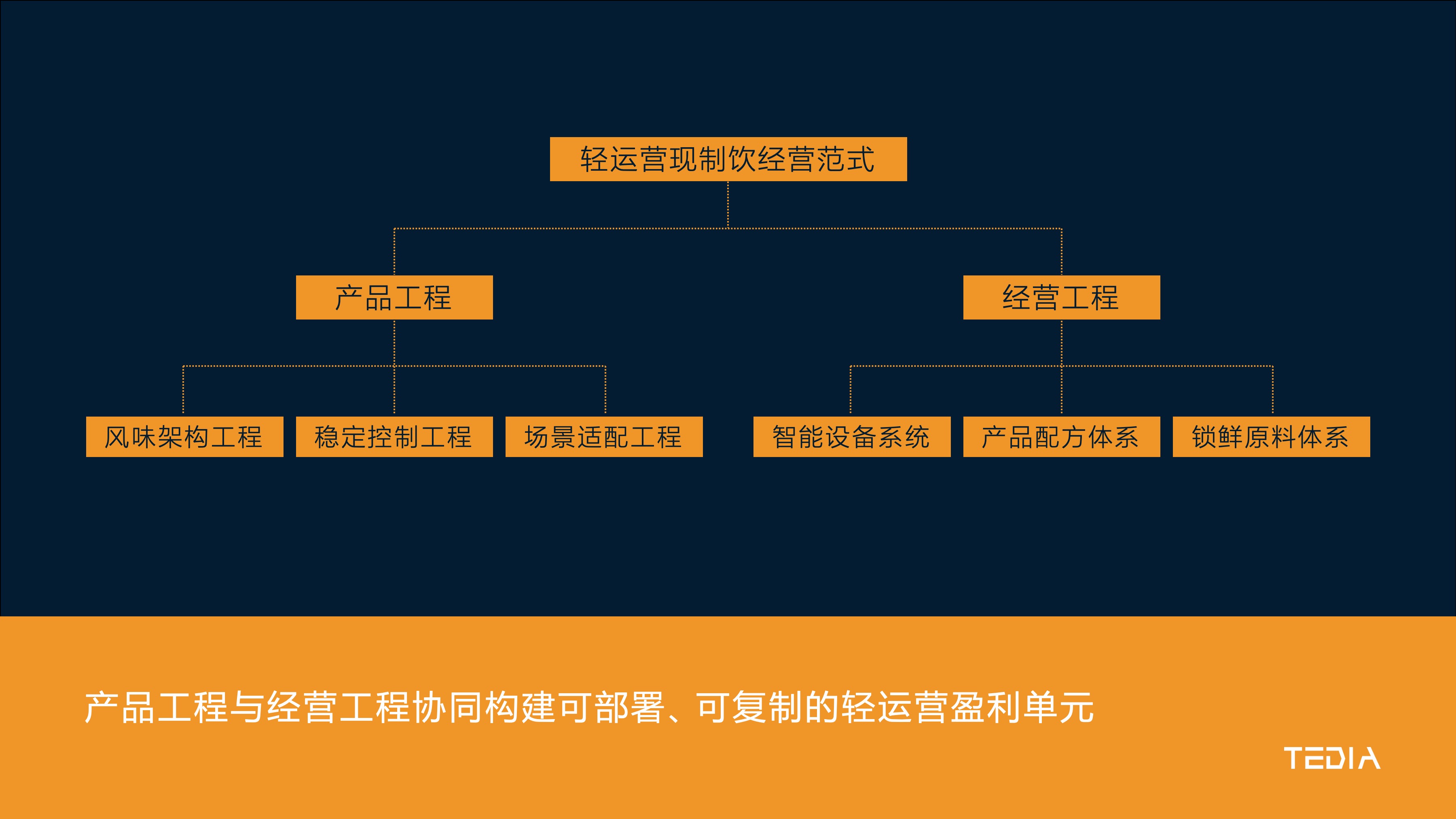
This means:
No reliance on specific personnel
No dependency on ongoing training
No increase in organizational complexity
In practice, this model operates as: Deploy → Operate → Stabilize
Operating Model: Capability as Profit Structure
Once key variables are locked, freshly made beverages are no longer a business line—they become predefined profit modules.
These profit modules have three characteristics:
Clear cost per cup
Deterministic gross margin per cup
Predictable total output
Thus, the logic of operation fundamentally changes: Profit is no longer dependent on process management, but on structural design.
The core value of the TEDIA model lies in transforming uncertain operational outcomes into deterministic profit outputs.
Deployment Approach: From “Business Trial” to “Profit Unit Deployment”
Deployable profit units represent the correct operational form of freshly made beverages in group catering.
These units are characterized by:
Immediate operation upon deployment
Stable performance upon operation
Profitability upon stability
Operational Forms in Group Catering
Standalone Unit – Direct revenue conversion from traffic
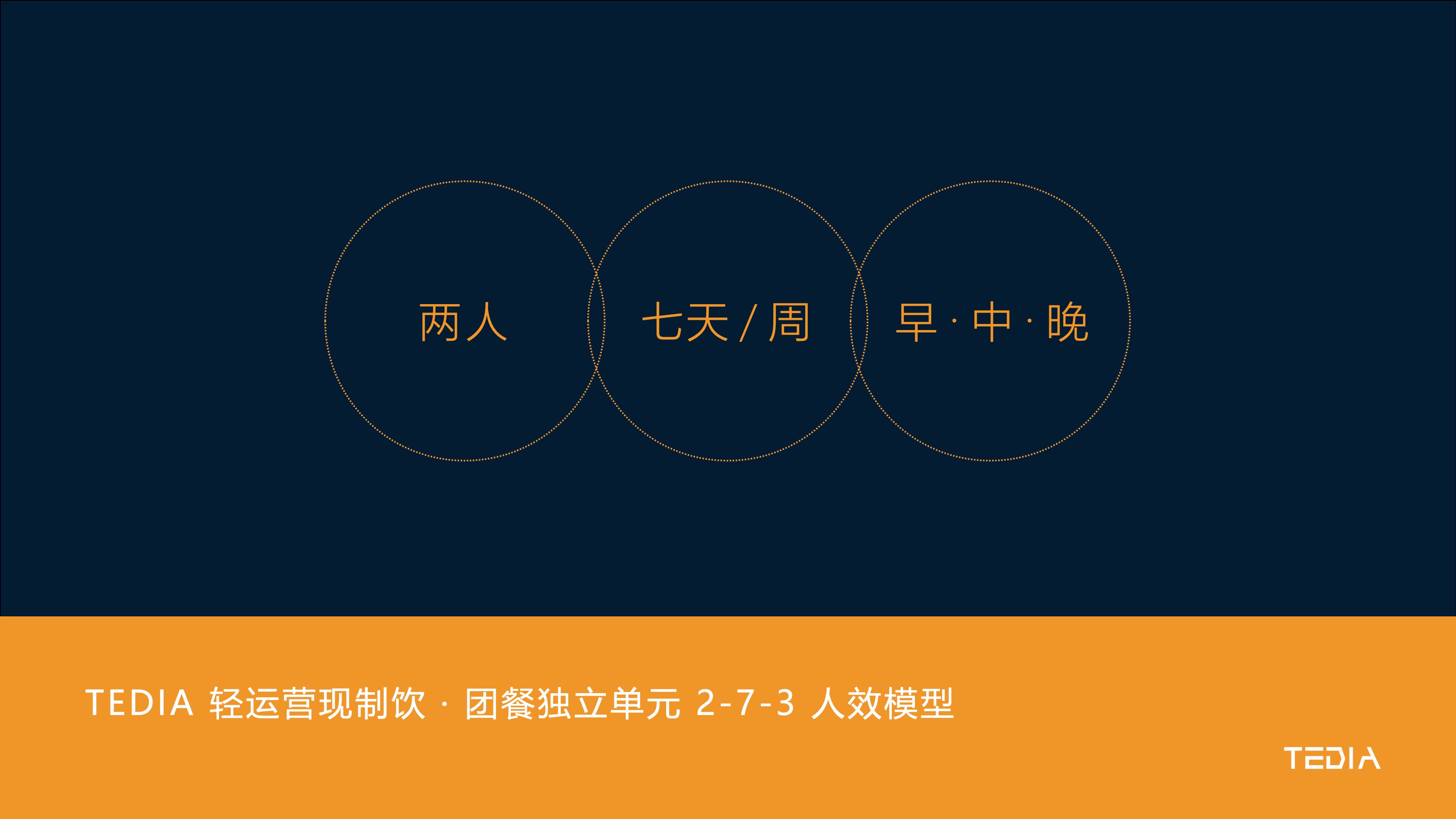
Proven in practice to operate across all meal periods (breakfast, lunch, dinner) with approximately two staff
Stable long-term operation supported by the system
Note: Based on TEDIA’s 2-7-3 labor efficiency model for group catering standalone units, which relies on engineered control of dispensing processes rather than labor intensity.
Embedded Unit – Profit enhancement within existing systems
Requires less than 0.5㎡ of space
Seamlessly integrates into existing service flows
Operated by existing staff with partial customer self-service
No additional space or staffing required
Converts existing traffic into stable incremental profit
Common principle: No disruption to existing systems—only the addition of deterministic profit.
Scalability: Replicating Capability, Not Experience
Traditional freshly made beverage operations are difficult to scale because: They rely on people → therefore, they cannot be replicated consistently.
Under TEDIA’s light-operation paradigm: What is replicated is the pre-engineered product structure and output capability.
No reliance on human expertise
No distortion across different spaces
Consistent results across locations
Scaling is no longer a complex challenge of training and management—it becomes a straightforward process of deploying profit units.
Conclusion
Capability structure is the defining boundary of freshly made beverage operations in group catering.
When operations rely on manual preparation, results cannot be consistently achieved within self-operated systems. Once key variables are locked through product engineering, output and cost become definable and reproducible, transforming into a deterministic operational capability.
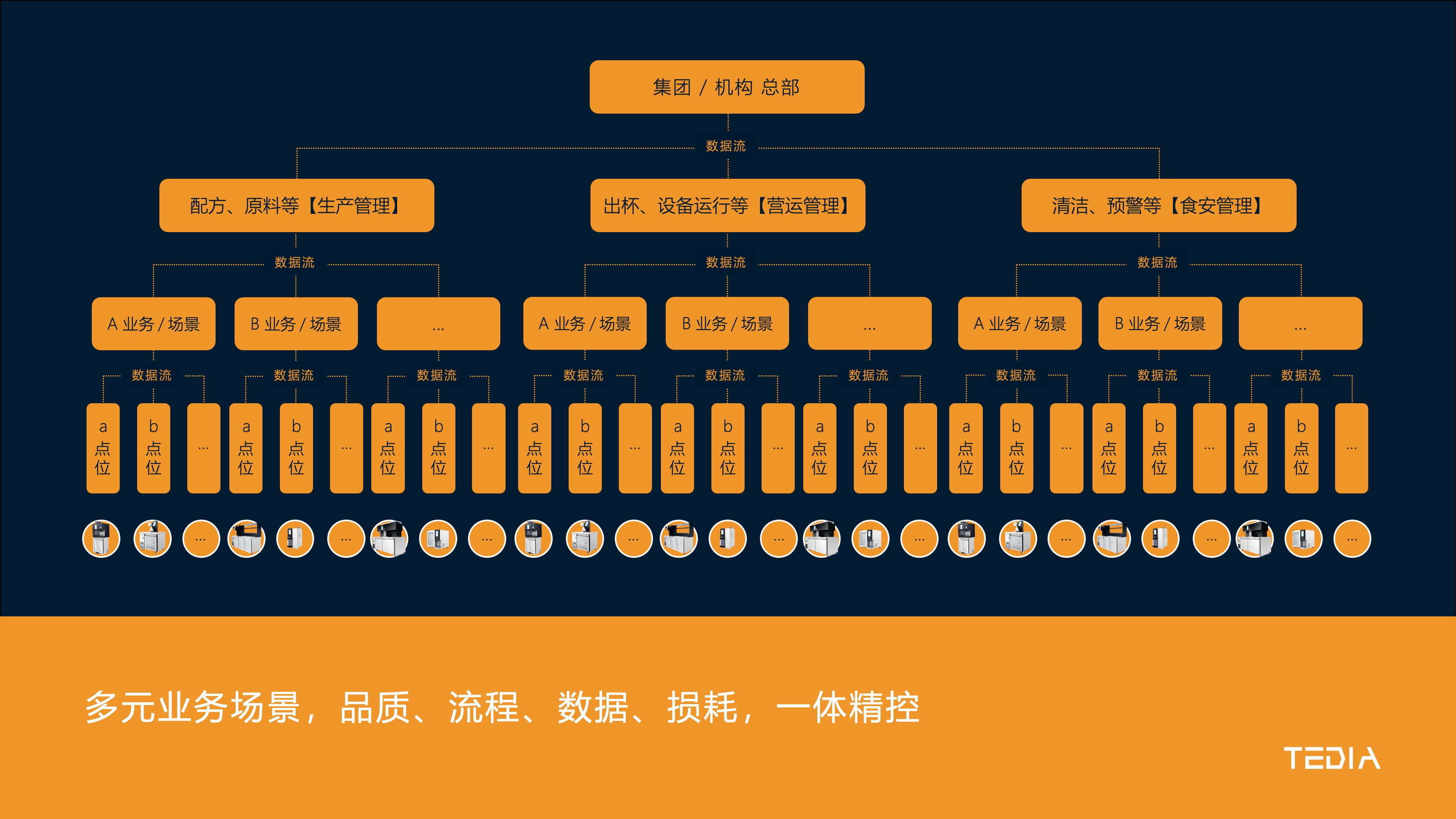
Through TEDIA’s light-operation paradigm— “Intelligent Beverage Equipment System + Standard/Customized Formulation System + Fresh-Locked Ingredient Supply System”— a five-dimensional certainty is achieved through integrated deployment:
No reliance on specific personnel (management certainty)
Clear and precisely quantifiable costs (financial certainty)
Autonomous product and pricing control with profit ownership (revenue certainty)
Ready-to-deploy without restructuring operations (operational certainty)
Replicable across regions (scalability certainty)
Within this capability structure, freshly made beverages are no longer a business requiring continuous management and trade-offs, but a profit unit established before deployment.
For group catering enterprises, this means: A portion of profit that was previously outsourced can now be reclaimed and internalized as a deployable, calculable, and replicable profit-generating capability.
Whether this transformation is achieved will determine whether freshly made beverage operations remain externally outsourced—or become a stable, internal profit engine within the system.
Related Reading:
The Made-to-Order Tea Beverage Business Paradigm: Engineering Deployable and Replicable Light-Operation Profit Units
Product Strength in Freshly Prepared Beverages from a Product Engineering Perspective — An Analysis of the TEDIA Light-Operation Tea Beverage Business Paradigm



 返回
返回